


Margarine vs Vegetable Oils: Introduction What They Are:
Margarine vs vegetable oils often share kitchen space, but they come from different stories. Margarines began as a butter substitute made by solidifying vegetable fats.
Today’s margarine formulas usually blend refined oils, water, emulsifiers, and sometimes dairy components, which gives them a spreadable texture.
On the other hand, vegetable oils are extracted from seeds and fruits (such as olive, sunflower, and canola).
Importantly, extraction and refining change both flavour and stability. Before you pick a fat, consider what you are cooking, how you will heat it, and what you want in terms of taste and health.
Ultimately, the right choice depends on both the recipe and your nutrition goals.
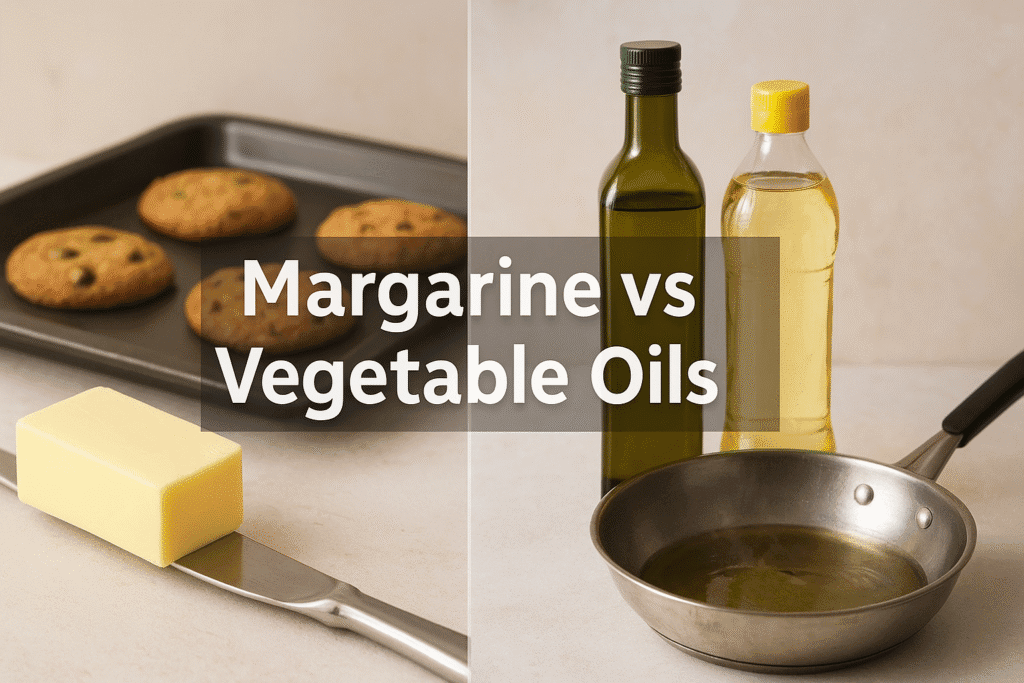
Margarine vs Vegetable Oils: What Is Margarine?
- Forms: margarines come in several types: Stick, tub, light, & whipped.
- Stick vs tub: A stick margarine is firmer because it contains more saturated fats; tub margarine is softer and uses more liquid oils.
- Labels can mislead: don’t rely on marketing claims-read the ingredient list.
- What to avoid: skip products that list “partially hydrogenated” oils (a source of industrial trans fats).
- Fortified options: choose spreads fortified with vitamin A or D if you need those nutrients.
- Modern formulations: many current margarines are reformulated to minimise transfers and boost monounsaturated fats, a clear improvement over older recipes.
Margarine vs vegetable oils: what are Vegetable oils?
Margarines vs vegetable oils: Vegetable oils vary widely.
Extra-virgin olive oil offers a rich aroma and heart-healthy monounsaturated fats, while canola and sunflower oils span a broad range, from high-oleic types to polyunsaturated blends. Cold-pressed oils retain more antioxidants but often withstand lower heat; refined oils tolerate higher temperatures but lose some nutrients.
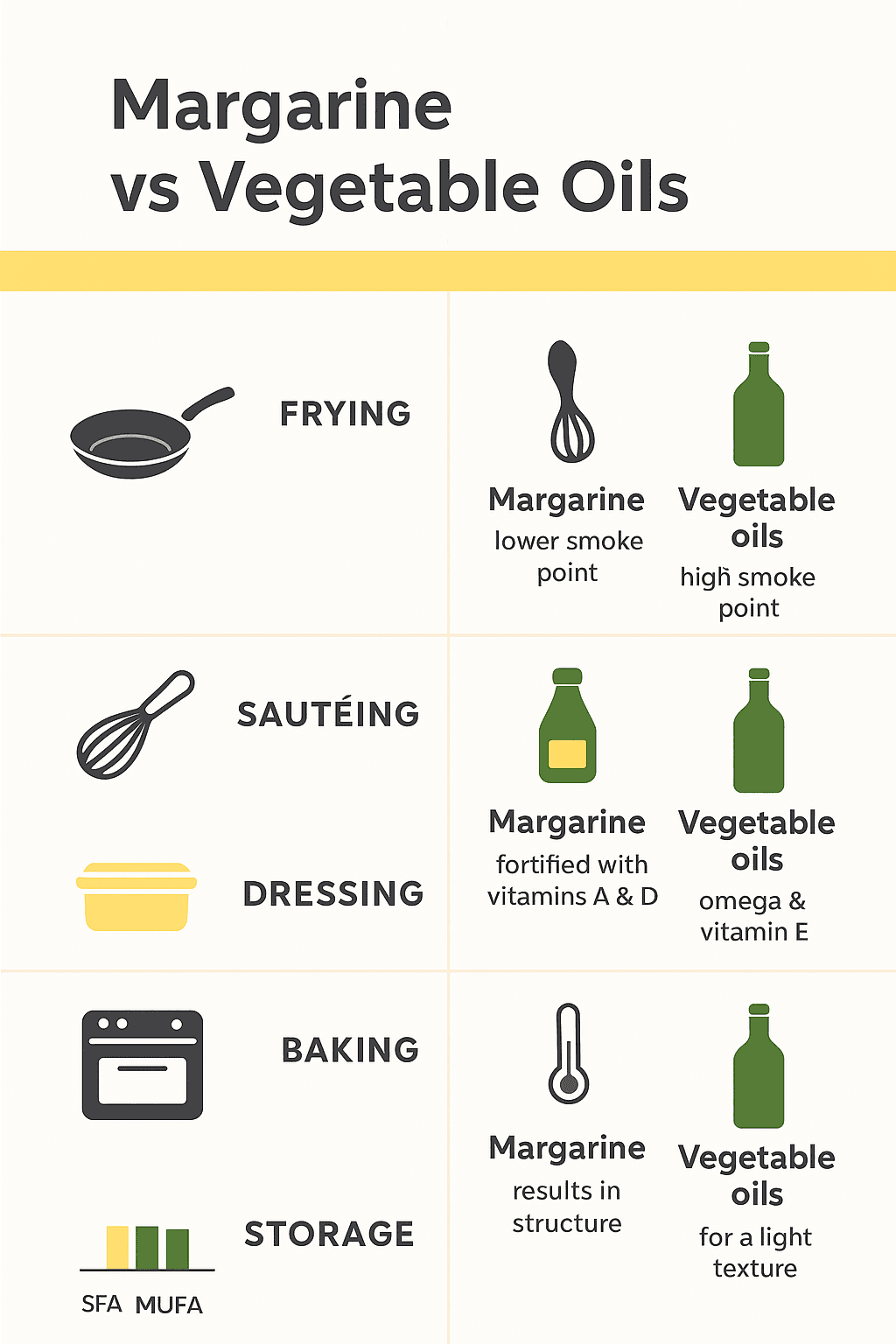
So, match oil type to the job: dressing and finishing use flavorful oils, high-heat frying calls for refined, heat-stable oils.
Margarines vs vegetable Oils: Nutritional Composition and fatty-acid Profile:
Margarines vs vegetable oils differ mainly in the balance of saturated, monounsaturated (MUFA), polyunsaturated (PUFA), and any trans fats.
Generally, swapping saturated or trans fats for unsaturated vegetable oils improves cholesterol numbers and heart risk markers.
Moreover, some oils add antioxidants and vitamin E, which help protect the oil from oxidation.
Therefore, when you choose, check both the fatty-acid profile and the ingredient list. Simple decisions here can have meaningful health effects over time.
Fatty acid profile (typical % of total fat, approximate):
| Fat / Oil | Saturated fat (SFA) | Monounsaturated (MUFA) | Polyunsaturated (PUFA) | Trans fat (typical) |
| Margarine (stick, older) | 20-35% | 30-50% | 10-25% | Historically, up to 5% (now usually ~0) |
| Extra-virgin olive oil | 10-15% | 65-75% | 8-15% | ~0% |
| Canola (rapeseed) oil | 6-8% | 55-65% | 25-35% | ~0% |
| Sunflower (linoleic) oil | 8-12% | 20-30% | 55-65% | ~0% (varies) |
Note: Manufacturers and cultivars shift these values; Read labels for exact numbers.
Overall, vegetable oils usually provide more unsaturated fats than traditional margarines unless the margarines use high-oleic oil blends.
Margarines vs Vegetable oils: Cooking performance, smoke point & stability.
| Aspect | Refined vegetable oils | Extra-virgin olive oil | Margarine |
| Heat tolerance | highly good for frying | Moderate fine for sautéing | Lower can burn at a very high heat |
| Stove behaviour | Heats evenly, low splatter | Stable (antioxidants), adds flavour | Contains water splatters, Browns differently |
| Baking texture | Poor for creaming | Not for creaming, best for dressings | Excellent for creaming and structure |
| Best use | High heat frying, neutral cooking | Sautéing, dressings, finishing | Baking, spreading, recipes needing solid fat |
Research based data: What science tells us:
Research-based data consistently show that replacing saturated and trans fats with unsaturated vegetable oils reduces LDL cholesterol and lowers cardiovascular risk.
In addition, randomised trials and meta-analyses point to improved lipid profiles when people switch from butter or trans-rich spreads to vegetable oils or trans-free margarines.
Notably, public health campaigns worldwide targeted industrial trans fats for removal because even small intakes raise heart disease risk.
Therefore, the evidence supports choosing unhydrogenated vegetable oils or updated margarines that do not contain partially hydrogenated oils.
Health impacts and dietary guidance:
- Both can fit a healthy diet, but how you use them matters.
- Prefer unsaturated fats (MUFA & PUFA) over saturated and trans fats to support heart health.
- Watch calories; Fats are energy-dense, so practise portion control for weight goals.
- Follow medical advice if you have heart disease or other health conditions.
- Swap from butter or trans-containing spreads to unhydrogenated vegetable oils or modern trans-free margarines when possible.
- Read labels: “no partially hydrogenated oils” is a good sign.
Comparison of Asian vs European people’s preferences.
In many Asian kitchens, cooks often use soybean, peanut, or palm oil because they are affordable, have a neutral taste & work well for quick, high-heat frying.
In contrast, Mediterranean and European households usually prefer olive oil for daily cooking and dressings due to its rich flavour and long culinary tradition.
When it comes to spreads and margarines, tastes also differ: Europeans tend to choose soft, butter-like spreads or olive oil-based margarines, while many Asian markets favour hard margarines or palm-based blends, especially for commercial frying.
Overall, local cooking styles, cost, and cultural habits play a significant role in deciding whether people use margarine or vegetable oils in the kitchen.
Margarine versus vegetable oils: Best fats for children’s growth & health:
| Aspect | Margarine | Vegetable oils | Expert recommendation |
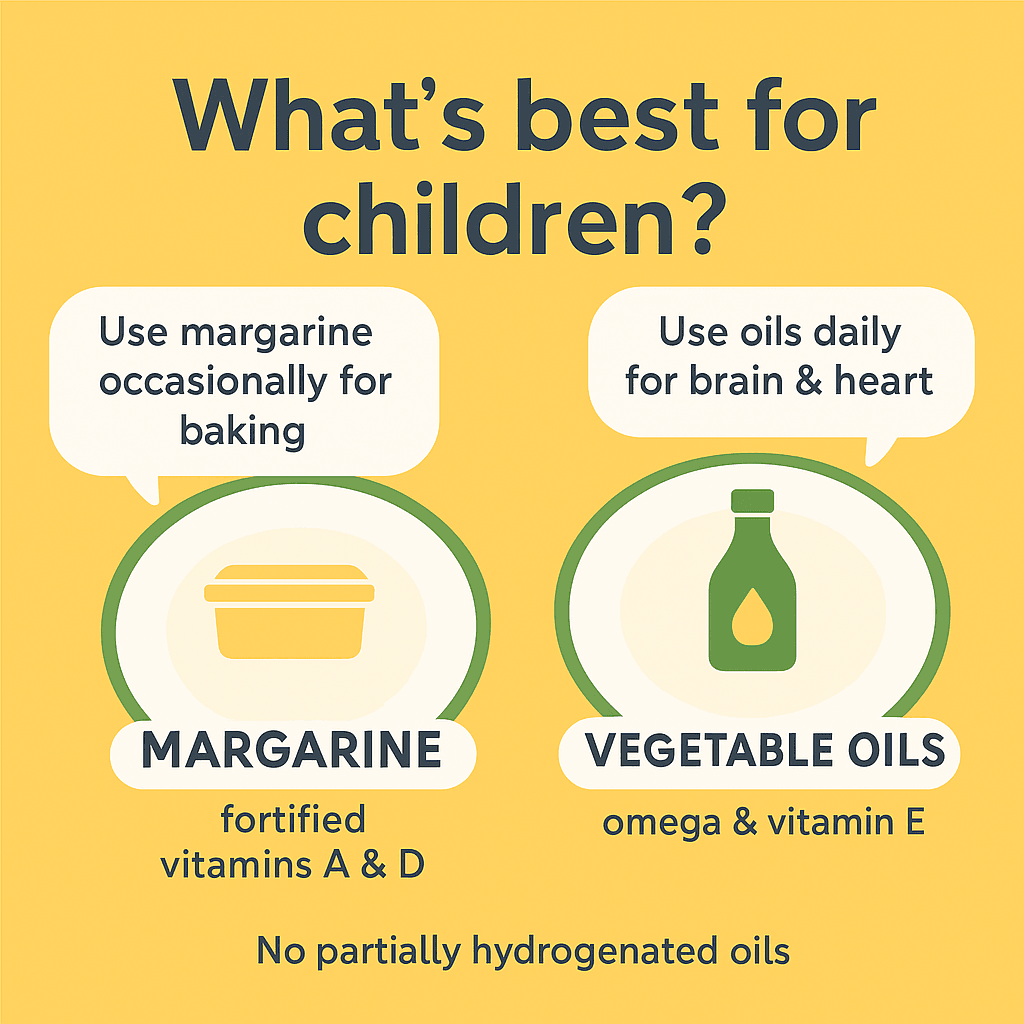
| Nutritional profile | Fortified with vitamins A & D; may contain more saturated fat. | Rich in healthy MUFA & PUFA; supports heart & brain health. | Prefer vegetable oil; Use trans-free margarine occasionally. |
| Effect on growth | Gives energy, but high intake may add saturated fat. | Aids brain and nerve growth with Omega-3 fats. | Use small daily amounts for balanced growth. |
| Digestibility | May have emulsifiers; heavier for digestion | Neutral and easier to digest. | Vegetable oils are lighter and better tolerated. |
| Usage tips | Best for baking & spreading; check “no hydrogenated oils”. | Ideal for light frying and dressings. | Use oils for cooking, a margarine sparingly for taste. |
| Conclusion | – | – | Vegetable oils are generally the healthier choice for children. |
Margarine vs vegetable oils: International standards and recommendations.
Global health bodies recommend minimising industrial trans fats and shifting to unsaturated vegetable oils.
Many countries now restrict partially hydrogenated oils or require clear labelling. Moreover, food safety agencies advise on the reuse of frying oil: avoid repeated deep-frying cycles and discard oil that darkens or smells rancid.
For manufacturing and labelling, international standards address trans-fat limits, allowable additives, and fortification (example: vitamin D in spreads).
Therefore, the safest consumer choice is to follow these standards: choose unhydrogenated products and follow proper storage and reuse guidelines.
Practical guidance: How to pick and cook with fats:
- For frying: use refined, heat-stable oil such as high-oleic canola, refined sunflower, or peanut oil.
- For sautéing & everyday cooking: choose extra-virgin olive oil for both flavour and health benefits.
- For baking: Select margarines or solid fats when the recipe requires creaming for texture, and ensure they are trans-fat-free.
- For dressings and finishing, prefer cold-pressed oils to enhance taste and aroma.
- For storage: keep oils in cool, dark places and discard any that smell stale or Rancid.
- For health: always read labels, avoid products with “partially hydrogenated” oils, and use moderate portions.
Conclusion, Quick Takeaways:
Margarine and vegetable oils both have functional roles. Choose unhydrogenated vegetable oils or modern trans-free margarines over trans-rich or high-saturated options.
Match the fat to the cooking task: oils for high-heat cooking and dressing; margarines for certain baking textures. Above all, focus on unsaturated fats, read labels, & use fats in moderation.
Disclaimer: The content on this website is for general informational and educational purposes only. It is not intended to provide medical advice, diagnosis, or treatment. Always consult a qualified healthcare professional, doctor, or dietitian before making any changes to your diet, exercise routine, or lifestyle. Reliance on any information provided on this site is solely at your own risk.
Is margarine worse than vegetable oil?
Not necessarily. Older margarines with industrial trans fats were worse, but many modern margarines are trans free and can be comparable to some oils.
Which oil is best for frying at home?
Refined high-oleic oils (canola, refined sunflower, refined avocado), as well as peanut oil, work well.
Are margarines & vegetable oil interchangeable in recipes?
Sometimes. For texture-dependent baking, stick with the recommended fat; For cooking, you can often swap in a neutral oil.


